Toronto certainly has many, many music stores where one can find musical instruments, books and more.
Below you’ll find a list of stores we recommend at our music school in Toronto. We’ve highlighted the pros and cons of each shop with the busy parent in mind. Enjoy!
Long & McQuade: our first choice
Long & McQuade is a great place to buy musical instruments and books because it’s just so big! They keep a wide variety of items in stock at all times. They have good prices, usually good customer service, and for the first-time student, they have a rental program so you can try before you buy. They also have frequent sales and free parking.
This is the first store we recommend to new students because they seem to have everything you will need!
Cons? Because they are so popular for musicians of every age, their shop can become overcrowded at times. Their piano selection is limited.
Steve’s Music: in the heart of downtown Toronto
You’ll find Steve’s Music on Queen St. just east of Spadina. They have a great, trendy location and the store is frequented by many famous musicians.
Steve’s is a guitar player’s dream; they cater toward guitarists and have a great selection of instruments and books.
Cons? The customer service is not always friendly. You must ask permission before you touch anything. For a young kid in a guitar shop, this might be difficult!
We also recommend Allegro Music, Dave Snider Music Centre and St. John’s Music Centre.
For instrument-specific needs, here are some more recommendations:
Piano: Remenyi House of Music, Robert Lowry Piano Experts
September is upon us, and there is no better time to start thinking about regular music practice.
Playing a musical instrument is a great skill to have, and it’s best developed over time, not all at once. We learn a new note, or a new chord one day. A week later we are able to play a new song.
Some students try to cram as much practice time in the day before (or the day of) the music lesson — maybe right before the music teacher walks through the door!
Practicing regularly is as integral as brushing your teeth, and needs to be done in small doses every day. Think about it this way: you brush your teeth for a few minutes a day. If you tried to brush your teeth once a week — but for an hour — well, that would be interesting, but probably wouldn’t keep your breath fresh.
So back to practicing music — how much time needs to be spent on it?
Let’s look at three different student levels; beginner, intermediate and advanced.
Beginner students: 5 minutes + their age
A good rule of thumb for beginners is that students should practice approximately 5 minutes + their age every day.
For example, a 7-year-old beginner student should practice 12 minutes every day (7 + 5).
Intermediate students: 10 minutes + their age
An intermediate student is someone who has been enrolled in music lessons for at least two years and has shown significant progress since they began.
For example, a 9-year-old student should practice 19 minutes every day.
Advanced students: 20 minutes + their age
An advanced student is someone who has been enrolled in music lessons for at least four years and shows potential for becoming an expert someday.
Advanced students should practice 20 minutes + their age every day.
For example, a 16-year-old advanced student should practice 36 minutes every day.
These are suggestions and can be adapted by the parents or by the music teacher as they see fit, depending on the student’s schedule and ability.
What if I miss a day?
Inevitably there will be days when music practice is forgotten or skipped altogether. In this case, it’s best to split up the lost practice time over the full week of practicing.
For example, if a 10-year old intermediate student is going away for the weekend and won’t be able to practice on Saturday, the student could break up the 20 minutes into seven days following the Saturday that they’re away. The practice schedule would look like this:
If a student is away on vacation for an entire week or longer, there likely won’t be an opportunity to make up the lost time. In this case, parents must do their best to get their kids back into a regular routine as soon as they return.
It’s the last week of summer, and a new school year is just around the corner.
To help ease the transition, consider these ideas for resuming music lessons this Fall.
Stay compassionate
If you’ve been away on vacation, your child was likely unable to play their musical instrument for the entire summer. Keep in mind that there will be a review period — it will take some time for your child to be playing at the same level as they were in June. This is to be expected, and their music teacher will have prepared for this. The teacher will go over previously learned material and may bring exercises to help rebuild the technique.
If the student feels they have taken a step back in their playing ability, the first few lessons can be frustrating. It’s important for you as the parent to be compassionate and upbeat. Eventually the review period will be over and your child will be able to progress further, and they will have a newfound sense of accomplishment and confidence.
Motivate
Help your child become excited about their music lessons again after the long break. Maybe this involves playing music together, listening to music, watching a musical performance on YouTube, or finding some practice incentives (stickers seem to work well).
Have a conversation with your child about what they like most about their music lessons or music teacher. If you took music lessons once, share a funny story or two. Remember that music can be fun and educational.
Create a Routine
Kids study best when they have a designated studying area and a set time. Music practice is the same. Once you’ve scheduled your music lessons for September, it’s time to start thinking about a music practice schedule. Try to find a regular time for three days a week that will work best.
And remember — it may take some time for your child to get back into the routine of regular music practice after being on vacation. You may decide to start with one or two practice sessions a week, and then add more practices or longer practices from there.
Today we found a great video explaining the different parts of the violin, including the fingerboard, the bridge, the body, ribs, pegs and more! Hope you enjoy.
Whether your child is already signed up for or is just about to sign up for music lessons, they may be eager to learn a cool new instrument. As the parent, you go and find a qualified music teacher in your area, and you schedule the first lesson.
But when the big day arrives, your child may be experiencing some apprehension.
Why?
Your child is meeting a new teacher, and likely has no idea what to expect from their first lesson. Will the teacher be nice? Will the teacher expect them to learn everything in one class? Will learning the guitar, piano or violin be too hard?
We are writing this article today to help all the new music students out there, and to give some insight into what to expect at the first music lesson with Firefly Music.
Meet and greet with the music teacher
At the first lesson, it’s important for the new teacher to establish a rapport with your child. They may ask about the child’s musical tastes (“What is your favourite song?”) and about their musical background (“Do you take music class at school”?).
The music teacher may ask about goals, although some young students may not be able to answer this question yet.
Most of all, the teacher will be trying to make a friendly connection with your child so that they feel more comfortable. Every music teacher was once-upon-a-time a nervous music student too!
Learning about a new instrument
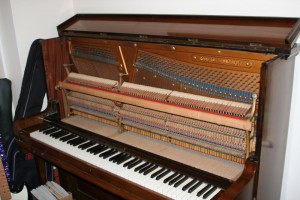
Before playing a single note on piano, violin, ukulele, guitar or drums, the music teacher will explain some of the mechanisms involved in the instrument. A piano teacher may begin by talking about how pianos work — hammers hitting strings. Another teacher might compare the guitar to a person — with the guitar “neck”, the “head”-stock, and the guitar “body”.
Talking about the musical instrument in this way allows your child to get a better understanding of how the music is made. Your child may even share some of this knowledge with you when the lesson is over!
Playing music for the first time
And then there’s the moment when your child gets to play. Finally!
The teacher may start off with playing posture, which is an important concept for young children to understand. They will also talk about the fingers and the hands.
At this point your child has likely absorbed a LOT of information for one lesson. Depending on how much information has been passed on in the first lesson, the teacher may decide to teach your child a simple song or a few simple notes during the second lesson. It’s important that the music student not feel overwhelmed, but that they feel satisfied and hungry to learn more.
Finally, the teacher may speak to you about a good music book to start off with for lessons.
We hope this article has helped today, and we wish your child many, many years of music playing.
Today we’re talking to three of our guitar teachers about what they love about music, and how their guitar studies have taken them in diverse directions in their musical careers.
1. Benjamin Barrille: World traveler. Flamenco performer. And guitar teacher.
Benjamin has lived and breathed the flamenco guitar music for years and he writes to us from Sevilla, Spain where he is currently on a study trip.
Years playing guitar: 14
Why do you play music?
I remember being very emotionally affected by music at a young age. I received a classical guitar as a gift from my mother who always aspired for me to play an instrument. I began to teach myself how to play simple chords and melodies from various resources and simply fell in love. I simply cannot imagine my life without it now.
I have had a number of teachers throughout my musical career that encouraged me. What I discovered is that as a musician, almost anyone in life can be your teacher even if it’s just for a moment. That one new chord you may have picked up can explode into a flurry of new ideas. And so I believe that despite being an educated musician, my true university is the people you encounter in life.
What’s the best part of teaching young children guitar?
Often students tell me that they could never imagine being able to play certain songs because they might sound very difficult. My job is to help demystify these beliefs and help them realise that it is possible. The sheer look of joy on their faces when they finally discover that it is indeed possible with the right amount of dedication makes it all very worthwhile for me.
Tell us about the journey your guitar training has taken you on.
Within two years of playing guitar, I had my first gig playing a local bar. When I graduated high school, I was unsure about what I wanted to do. I knew I enjoyed music, but what mystified me the most was flamenco guitar and the music of Spain. I decided to travel to Spain in search of flamenco and what would become the most self-defining journey of my life. Since then, I’ve been returning to Spain often to continue my studies. I have studied with many great maestros of the art form and my experiences have afforded me the opportunity to perform and record with many great artists and companies, such as: El Mosaico, The Cafe Ole, Compania Carmen Romero, and the Esmeralda Enrique Spanish Dance Company.
I am continuously composing and one day I plan to release something of my own to the world. In the meantime, I’m enjoying the journey so far!
2. Joshua Piche: Multi Instrumentalist. Jazz musician. Guitar teacher.
Joshua hails from Manitoba where he earned a Bachelors Degree In Jazz Studies from The Brandon University School Of Music. Today he lives, performs and teaches in Toronto.
Years playing guitar: 18
Why do you play music?
When I am listening to my favourite music or playing one of my favourite songs, it’s like being transported to another world, where everybody on stage is listening to each other and communicating. Where you don’t have a worry in the world and where anything seems possible. That’s why I love playing music.
Tell us your favourite memory as a guitar student.
When I was in Grade 6, I heard a song by Don McLean song called “American Pie” and it had an incredible energy to it. I could listen to the song over and over again on my cassette player and never get sick of it. It was a long song, with about 15 chords in it and tons of words. But I saw it as this mountain, and I worked on that tune every day — and before I knew it, I was at the top. I had learnt the tune! It was one of the first milestone tunes for me on guitar.
What’s the best part of teaching young children guitar?
It’s always cool to see young students progress over the years. Especially when you have longterm students for 5-6 years. You get to see the evolution that takes place from a students first stumbling notes, to their performances of complex and advanced repertoire. Knowing that I played a small part in that evolution is really rewarding!
Tell us about the journey your guitar training has taken you on.
Music has always been a part of my life. My Mom has these old VHS tapes of my sister and I as children during “Family Music Night” which was always our Saturday night. My Dad would play the guitar, and I would bash on the drums while my sister tried to be heard on her violin. It was just something that I became hooked on very early and it was always something I was compelled to do for the enjoyment of it. Now I look at where music has taken me, and it’s all I do. I’m teaching it, I’m performing around Toronto and North America but I am still doing it because I love it. It was never something I chose to do, it was something of a calling that I could not ignore.
Jordann is a talented pianist who also teaches guitar with Firefly Music Lessons. She has answered the questions below from a pianist’s point-of-view.
Years playing piano: 25
Why do you play music?
It inspires me, calms me, and makes me feel happy!
Tell us your favourite memory as a piano student.
I loved anytime I was able to get a hard passage — I’m classically trained, so I had to learn a lot of hard pieces.
What’s the best part of teaching young children piano?
Seeing the enjoyment they get when the piece comes together!
Tell us about the journey your piano training has taken you on.
I’ve music directed a lot of theatre productions, and had to hire other musicians. Playing in the “pit band” with other musicians is an awesome feeling. Hearing this great sound that, as a band, you are making — but you, as a piano player, are a part of. It’s magical. Music directing and conducting Broadway musicals has definitely been the best part of the journey!
Tips for a Great Recital: It’s OK to Make Mistakes
An article by Dan H of Firefly Music Lessons.
As a piano teacher, I believe the most important lesson for playing in a recital is to be cmofrotable maknig mskates!
Young students will most likely be nervous about performing in front of other people. A young student’s nervousness can then cause a chain reaction where making more mistakes makes them even more nervous. I’ve seen students get so nervous that they had to restart their songs on stage, or they would stop playing altogether. When that happens it can be an embarrassing experience for the student.
The goal of the recital is to help students reach a higher level of musicianship and to celebrate what they have accomplished during the year. So it’s a shame when a student feels badly after their performance.
Here’s an idea to help:
When I’m preparing my students for a recital, I force them to play wrong notes on purpose to get comfortable with the idea of making mistakes! My students find this a bit strange at first, but after a couple tries, they have a lot of fun with it. I also make them play the whole song without stopping. If they make a mistake, whether on purpose or by accident, they have to move on to the next note. It’s kind of like going through an obstacle course; the goal is to just get through it and make it to the end!
On the day of the recital last June, my students weren’t nervous. They were excited! Every student of mine made a mistake in their performance, but none of them were phased by the mistake. I had successfully trained them to embrace the inevitability of making mistakes and to just have fun.
Eventually, after years of lessons and several recitals, I like my students to shift their focus away from performing a song correctly to performing a song beautifully. It is only then that my students will understand what it really means to be a musician.
As summer approaches and class time winds down, we start thinking more and more about the outdoors: camping, swimming, and cottage season.
But the warming weather doesn’t mean it’s time to shelve the musical instruments until September.
Here are a few ideas to create musical moments with your family all summer long.
1. Bring musical instruments to the cottage
When you’re packing the car for a trip to the cottage, why not bring along your child’s guitar, or a small set of hand drums? Piano students could bring along a small portable keyboard or xylophone.
If you have a family friend or relative who plays guitar, invite them over for a campfire singalong.
Singing together is a great way to build emotional connections with your children. You’ll be creating moments that will be remembered for years to come. Music is meant to be shared!
Here’s a list of five great campfire tunes to get you started. You can also sing these songs together acappella – meaning using your voices only, without guitars or other instruments.
2. Move that body: Musical “Freeze” Dance
Kids love to move, and the “Freeze” Dance is a great way to combine valuable exercise with music.
Also called Musical Statues, this activity involves dancing until the music stops abruptly. When the music is off, the child must “freeze” in place. The dancing resumes when the music starts up again. You can use a portable stereo or play a guitar.
At an early age, children are able to discern beat and rhythm in music, creating a strong urge to get up and dance!
Playing this game outdoors is an easy way to involve music in your summer activities, and you won’t have to worry about kids knocking over a lamp!
3. Make your own outdoor musical instruments
Some musical instruments are more suited to outdoor play than others – for example, you wouldn’t bring your child’s electronic keyboard outside! Or play a violin in the rain.
Drums are a great musical instrument to play outdoors not just because they are usually sturdy in construction. When played inside the house, drums can be overwhelmingly loud. In a wide open outdoor space, the sound level is more manageable.
Making your own musical instruments is a great creative activity, and the options are almost endless. You can make:
Xylophone out of tall glass jars with different levels of water (to create different pitches)
Rubber band guitar from an unused shoe box
With homemade musical instruments, you won’t have to worry about dirt and mud ruining them.
There are a ton of great resources on outdoor musical instruments from found objects as well. You can turn almost anything into a musical instrument. Here is a great article with many examples.
And now, it’s time for a cute song by Jason Mraz on the outdoors – featuring the cast of Sesame Street.
It’s available in the App store currently for $3.99.
Step 2: Tune the guitar string by string
Now it’s time to get out your guitar and start tuning!
The notes to tune your guitar to, from highest-sounding (thin 1st string) to lowest-sounding (thick 6th string) are:
EBGDAE
One way to remember this is using an acronym, such as:
Easter Bunnies Go Dancing At Easter
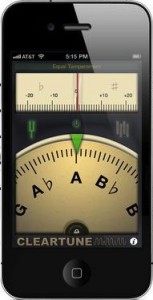
Here’s the cool part. Your phone has a built-in microphone so you’ll be able to tune your guitar strings just by sounding them in the room. The app will listen to your guitar and tell you if you’re in tune.
If you have an iPod touch, you’ll have to use a pair of headphones with a built-in mic.
Play the thickest string (6th string: E). Watch the tuning app. When you are in tune, the note displayed will be an E, and there will be a green light. The green means you are in tune!
If you’re not in tune, here are a few things to check:
Check that the string is somewhat in tune — is the tuner showing an E? Or is it showing an Eb (E flat)… or worse — a note that’s not even close??
Look at the bottom circular dial. Are you to the right (sharp) or left (flat) of the desired note?
Look at the meter at the top. It allows for fine tuning and will actually show you exactly how sharp or flat you are (meaning how far out of tune you are!)
Once you’ve taken these steps, you’ll need to adjust your string accordingly by turning the tuning pegs of each string just a tiny bit at a time. Listen to the sound — is it changing (getting higher or lower)?
Very important — when tuning:
Make sure you are always striking the string when you move the tuning pegs. You want to make sure you’re not turning the tuning pegs TOO FAR which could result in a broken string. You also want to make sure you’re turning the corresponding tuning peg for the string you are tuning!
If you find you’re constantly turning the tuning peg in the same direction (higher or lower), stop for a moment. Do you have the right note? If you keep tightening a string, it will surely break. So double check that you have the right note.
Step 3: Check your tuning with a guitar chord
The best way to check the tuning of all the strings is to play a series of guitar chords. You could try playing an E chord to hear some of the beautiful OPEN strings, followed by a C chord, and a D chord, etc.
If the chords sound great, you’re ready to rock!
If the chords still sound off, try your tuner again and refine. Congrats — you’ve tuned your guitar!
Steinway & Sons, one of the prominent piano makers, says this about piano tuning:
“… no matter how expertly a piano is tuned, atmospheric variations and the nature of the piano’s construction constantly conspire to bring it off pitch.”
A piano tuner’s job is to produce a long-term tuning by stabilizing each string tension and releasing stress that is trapped in the piano.
Today we’ll talk about the environmental variations that affect the piano’s tuning, especially looking at humidity and the ways its effects can be reduced.
Atmospheric variations that affect piano tuning
Pressure changes
There is very little that can be done about changes in pressure. For the most part the effect on the piano is negligible.
Temperature changes
Temperature levels can vary greatly from day to night, and season to season. We normally have our piano in our living room, so temperature is taken care of by our furnace and air conditioning. The thermostats attached to the heating/cooling system can easily manage a temperature control within +/- 2 degrees C and 3-4 F.
Humidity changes
Now this can have a major effect in the tuning stability of a piano!
The air in winter contains very little humidity (low RH level) and on top of that, the furnace or other heating systems are working a lot in the winter months. This dries out the air even further. It is quite common to reach 20% RH levels during the winter in our homes. The opposite happens in summer, when it is relatively humid and warm, reaching the 60% RH level.
Wood is a highly hygroscopic material — meaning it easily absorbs and releases moisture from and into the corresponding environment. When wood absorbs water it swells and when it releases it shrinks.
On a piano, the soundboard will exert tension on the strings with high RH levels, and release it when the levels go down. Just imagine that the piano seems to be breathing with the seasons, and so the RH level changes!
How do I manage humidity levels?
Here are a few ways to mitigate the effects of humidity levels on pianos:
Use a humidifier on your heating system as well as in the room where the piano resides in the winter
Use air conditioning or a dehumidifier in the summer
Another good thing to have is a Temp/RH gauge to measure the RH level you are achieving in your home. It will maintain the RH levels within 40-50% by pumping humidity into the air or drying it. This will definitely help to get your piano in its best shape.
On top of tuning stability issues, a dry environment can seriously damage the piano in the long term, developing cracks in the soundboard and bridges. High levels of RH can make the keys stick and the action can become sluggish.
How often should I get my piano tuned?
Since we basically have in Canada two seasons — winter and summer (or winter and construction), I recommend getting your piano tuned twice a year.
If you tune your piano once a year, you are at least making an effort to correct the effects of the two seasons.
Here’s what two piano companies have to say on the subject:
Yamaha Pianos
“…a piano should be tuned at least twice a year.”
” Complete piano service should include periodic regulation and voicing in addition to tuning.”
Baldwin Piano Company
” After the first year a piano should be tuned at least twice each year.”
Keep in mind that every piano is subject to one or more factors that will make it go out of tune, including:
Humidity changes
Temperature changes
Stretching of strings
Slipping tuning pins
Hard use
How often you should tune your piano depends on its condition, the environment in which it is located, and the musical demands of the owner. A piano used mainly as a furniture piece probably won’t need to be tuned more than once a year. A piano that is played regularly and is in good condition would be better off with two tunings per year, each time the seasonal humidity changes. A piano given a daily workout by a professional, piano teacher or serious piano student might need to be tuned more frequently, maybe 4 times a year or more. At this level of use, it’s really up to the individual and at what point the tuning starts to bother them.
Students will benefit greatly from having their piano tuned at pitch for the fine education of their ears, apart from being more pleasant and the thing to do to maintain your piano.
Thanks for reading! Stay tuned for my next blog post where we’ll discuss pitch.